Mr Kidman's Classroom



Revise the key ideas
Higher noun phrases and reference
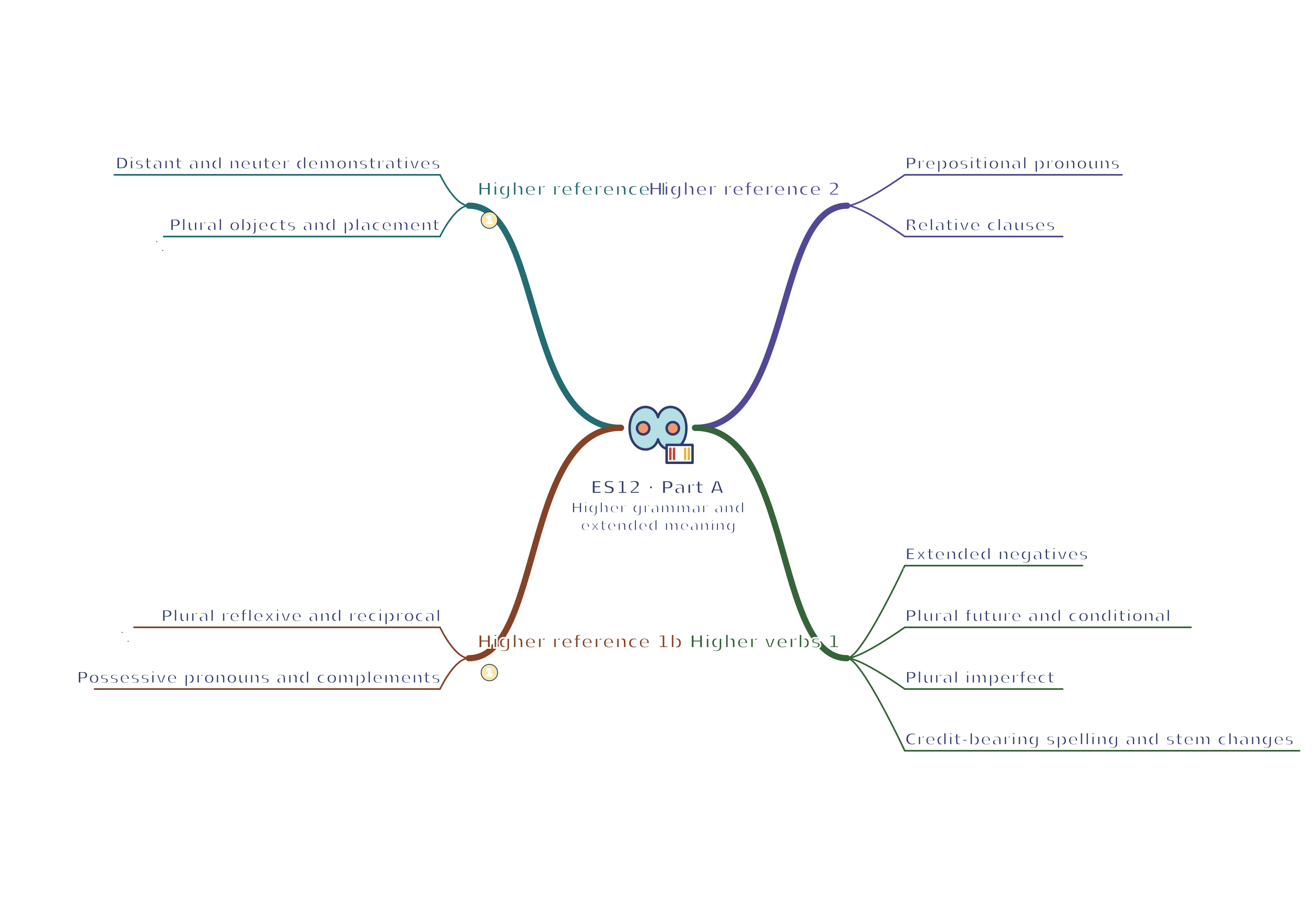
- Distant and neuter demonstratives — Aquel/aquella/aquellos/aquellas agree with a more distant noun: aquella casa. Aquello is neuter and refers to an idea or unidentified thing: ¿Qué es aquello? It does not modify a noun as an adjective. AQA tolerates ese as an alternative to aquel in production, but recognise both in comprehension.
- Plural objects and placement — Nos and os add us/you plural as direct or indirect objects: nos ve, os doy un libro. Put them before a conjugated verb or attach to an infinitive: os puedo ver = puedo veros. Do not infer direct/indirect function from the pronoun form alone; examine the verb and role.
- Plural reflexive and reciprocal — Nos lavamos means We wash ourselves; nos vemos can mean We see each other. Os entendéis and se besan can express reciprocal actions. Context distinguishes an action each person does to themself from an action they do to one another.
- Possessive pronouns and complements — El mío/la mía/los míos/las mías replace an owned noun and agree with it. El tuyo/suyo/nuestro/vuestro follow the same relationship. Este libro es mío uses a possessive as a complement without the article; este es el mío means this one is mine. Suyo needs context for the owner.
- Prepositional pronouns — Para mí, para ti, con él and con nosotros use pronouns after prepositions. Con + mí/ti becomes conmigo/contigo. A mí me gusta emphasises who likes something and retains me. Distinguish mí, me, from mi, my, by the accent and function.
- Relative clauses — Lo que means what/the thing that: lo que quiero. El que/la que/los que/las que and el cual forms agree with a referent (the noun or thing they refer back to) in suitable relative constructions. Donde links place, cuando time and que a related clause. Read the whole sentence to resolve which noun a relative clause describes.
Higher time and verb constructions
- Extended negatives — Ya no voy means I no longer go; tampoco voy means I do not go either. No tengo ni tiempo ni dinero means I have neither time nor money. A negative phrase before the verb can remove the need for initial no; a following one normally retains it. Preserve both neither/nor items.
- Plural future and conditional — Future adds -emos/-éis/-án to the infinitive for nosotros/vosotros/ellos: hablaremos, hablaréis, hablarán. Conditional adds -íamos/-íais/-ían: hablaríamos. Additional irregular stems sabr-, querr-, vendr-, dir-, saldr- apply in singular and plural: sabré/sabremos, diría/diríamos. Keep written accents.
- Plural imperfect — Add -ábamos/-abais/-aban for -ar and -íamos/-íais/-ían for -er/-ir: hablábamos, comíais, vivían. Irregulars include éramos/erais/eran, íbamos/ibais/iban and veíamos/veíais/veían. This extends Foundation's singular habits/background to plural subjects.
- Credit-bearing spelling and stem changes — Keep pronunciation with busqué, llegué, empecé and construyó; escoger gives escojo. Listed -ir families have third-person preterite changes: pidió/pidieron (e→i), durmió/durmieron (o→u). Learn the exact form, person and tense; do not apply present changes to every past person.
- Plural commands — Affirmative vosotros commands replace infinitive final -r with -d: hablar→hablad, comer→comed, vivir→vivid. Contrast tú habla and vosotros hablad. Use the required familiar singular/plural command, not a future form. Negative commands use another construction and are not produced by simply adding no.
- Present subjunctive — Required singular forms of hacer are haga/hagas/haga; ser sea/seas/sea; ir vaya/vayas/vaya; venir venga/vengas/venga; tener tenga/tengas/tenga. It is a mood used in specified contexts, not another past tense. Quiero que venga expresses a wish for someone else to come.
A mood is a set of verb forms used to present an action in a particular way, for example in a wish. Quiero que venga means I want him/her to come; it expresses the wish rather than stating that the person is coming.
- Subjunctive triggers and purpose — Cuando tenga tiempo, voy a ir refers to a future occasion: When I have time, I am going to go. Compare habitual cuando tengo tiempo, voy. Quiero que venga, me alegra que venga and te ayudo para que hagas el trabajo illustrate wish, emotion and purpose after que: I want him/her to come, I am glad he/she is coming, I help you so that you do the work. Check clause meaning; que alone does not always require subjunctive.
- Just completed and continuing — Acabo de llegar means I have just arrived, using acabar de + infinitive. Sigo estudiando means I am still studying; llevo dos años estudiando means I have been studying for two years. Estudio aquí desde hace dos años also uses present for a situation continuing until now.
- Passive constructions — El libro fue escrito por Ana means The book was written by Ana: ser + agreeing participle + por agent. Los libros fueron escritos has plural agreement. Se venden libros uses se + plural verb for books are sold; se vende una casa uses singular. This differs from unchanged hay.
In a passive sentence, the subject receives the action. The agent is whoever does it: Ana writes the book, so por Ana identifies the agent in the example.
- Impersonal judgements — Parece difícil means It seems difficult; basta means it is enough; falta agua means water is lacking; hacen falta dos sillas means two chairs are needed. Vale la pena estudiar means Studying is worthwhile. Agreement may follow what is lacking/needed, unlike fixed hay.
Comparison, sequencing and stress
- Superlatives and lo — La ciudad más grande is the biggest city; el mejor equipo is the best team. Add the article and compare within the stated group. Lo bueno means the good thing/aspect, turning an adjective into an abstract noun phrase. El mío is possessive; lo bueno is a different construction.
- Adverb superlatives — Es quien corre más rápidamente can identify the person running fastest; corre lo más rápidamente posible means runs as quickly as possible. Mejor/peor are irregular better/worse forms; use the whole sentence to distinguish adjective description from adverb manner. Do not insert más before mejor.
- Sequencing and questions — Antes de salir, cierro la puerta means Before leaving, I close the door; después de comer means after eating. Shared-subject sequences use an infinitive after de. ¿Con quién hablas? puts the preposition before the question word, unlike English Who are you speaking with?
- Default stress and accents — A written accent marks stress: café, teléfono. Without one, a word ending in a vowel, n or s normally stresses the penultimate (second-from-last) syllable: casa, hablan. Other endings normally stress the final syllable: hotel. To write an accent, compare actual stress with the default; third-from-last stress always needs an accent.
- Worked stress method — For canción the final syllable is stressed and the word ends in n, so an accent is required. For fácil the penultimate syllable is stressed but it ends in l, so mark the accent. Teléfono stresses the third-from-last syllable, so also needs an accent. Grammatical accents such as tú/tu and él/el distinguish functions as well.