What makes an event major — A major sporting event attracts substantial attention, organisation and resources. Participants and spectators are usually international, involving at least two countries, and audiences may attend or watch remotely. A single-sport event such as Wimbledon differs from a multi-sport Olympic Games in facilities, scheduling and participant needs.
Regular events — OCR uses regular for events such as the UEFA Champions League final: held each year, with the host city changing and potentially returning later. The repeated event creates planning and commercial opportunities, but a particular city does not host annually. Always specify whether frequency refers to the event or the host.
One-off hosting — In OCR's classification, an Olympic or Paralympic Games is a one-off event for a host city, typically once in a generation. The Games themselves recur internationally; one-off does not mean they happen only once ever. A host has limited time to recoup a large investment from that particular edition.
Regular and recurring — Regular and recurring events return to the same venue or city, such as Wimbledon or the British Grand Prix at Silverstone. Existing facilities and experienced staff can support repeated use and income. They still need maintenance and security each year; recurring does not mean risk-free or cost-free.
Participants and spectators — Athletes need safe training, accommodation and transport; spectators need tickets, information, accessible routes and crowd management. International visitors may require language support. Compare a multi-site Games with one tournament venue: the former has wider transport and coordination needs. Different user groups experience the same event differently.
Before the event
Bidding and uncertainty — A bid sets out why a city or country can host successfully. Preparing proposals, promoting the bid and demonstrating facilities cost money before selection is known. Success may attract investment and attention, but an unsuccessful bid can leave costs without event income. An attractive proposal must also be deliverable.
Infrastructure and investment — Before an event, organisers may develop venues, housing, transport and communications. Financial and commercial investment can improve an area's attractiveness to businesses. Public funds and private investment have different conditions and risks; a sponsor's contribution does not remove every public cost. Building must be affordable before projected visitor revenue arrives.
Employment before hosting — Construction, planning and event preparation can create jobs and training opportunities. Benefits depend on whether local people can obtain those jobs and whether skills transfer to later work. Temporary building jobs are useful but should not be described as guaranteed permanent employment.
Social objections and opportunity cost — Residents may object to disruption, displacement or public spending on venues while services need investment. Opportunity cost means the benefit given up when resources are used for one purpose rather than another. Compare what an event budget could otherwise fund, while recognising that transport or housing improvements may benefit residents too.
Pre-event judgement — For a fictional city, a proposal using existing venues may reduce construction costs, but transport upgrades may still be necessary. Weigh the bid cost, funding, jobs and objections before deciding. Do not count projected benefits as achieved outcomes or invent actual results for a real host city.
During the event
Social infrastructure and cohesion — Transport, accommodation and public spaces developed for an event can improve access. Shared support and volunteering may increase morale and social cohesion, meaning people feeling connected. Benefits depend on inclusion and affordable access; residents excluded by high prices or disruption may feel little pride.
Status interest and media — International coverage can raise the city's profile and increase interest in the sports shown. Successful home athletes can strengthen national morale. Poor performances or negative coverage of organisational failings can have the opposite effect. Visibility is an opportunity, not a guarantee of a positive reputation.
Tourism and employment — Direct event visitors may spend on accommodation, food and tickets; indirect tourism can arise when coverage encourages other visits or trips beyond event venues. Hospitality, transport and security may need extra paid staff. Volunteers also contribute, but unpaid roles are not paid employment. Some ordinary tourists may stay away because of crowds or prices.
Congestion litter and noise — Large crowds increase pressure on roads, public transport, waste collection and neighbourhoods. Extra services and clear routes can reduce the disruption but have costs. For a fictional stadium event, a park-and-ride scheme may lower car traffic while still producing congestion near its pickup site. Identify who experiences the drawback.
Safety and security risks — A high-profile gathering can increase opportunities for crime and create security risks, including terrorism. This does not mean an attack is inevitable. Planning, trained staff and proportionate security help protect people but add expense and can delay entry. Keep evaluation focused on risk management rather than unsupported predictions.
Regional inequality and criticism — Regions outside the host area may feel neglected if funding concentrates on event venues and transport. Negative reporting about queues, inaccessible facilities or poor organisation can weaken national status. Distributing events may spread benefits, but increases travel and coordination demands. Identify both the geographical distribution and the trade-off.
After the event
Sporting legacy — Legacy is what remains after the event. Reused venues, new clubs and trained volunteers can support lasting participation and raise a sport's profile. Inspiration must connect to affordable sessions, equipment and coaching. A new stadium alone does not prove that ordinary residents became more active.
Transport housing and investment — Transport improvements and adapted accommodation may serve residents long after competition ends. A stronger international profile can attract future tourism and business investment. Benefits depend on maintenance, accessibility and an effective conversion plan; promised housing is not an achieved legacy until it is delivered and usable.
Debt and unused venues — Hosting expenditure can exceed income, leaving debt or pressure on public budgets. Specialised venues may be underused yet still need maintenance; this is sometimes called a white elephant. A smaller event using existing facilities can avoid some costs, but its benefits may also be smaller. Assess total costs over time, not ticket revenue alone.
Reputation after hosting — Well-run events can leave positive memories, while scandals, poor organisation or disappointing home results can harm reputation. Sporting performance and event organisation are different: a host can organise safely even if its team loses. Support a judgement with relevant evidence rather than treating any defeat as proof the whole event failed.
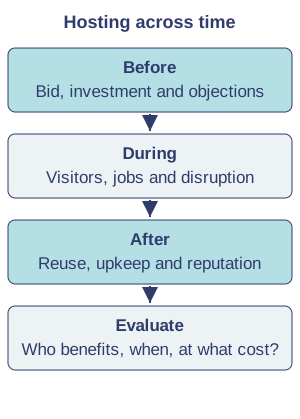
Evaluating a legacy — Compare immediate and longer-term effects for residents, businesses, athletes and public finances. Use evidence such as venue use, participation, jobs and maintenance costs, ideally against a pre-event baseline. London 2012 is a real one-off host example; this fictional planning discussion does not claim measured London outcomes. A balanced conclusion explains which effects matter most and why.Compare effects over time. Original illustration. Open full-size diagram
Event types and audiences
Judge a lasting legacy — A fictional stadium attracts events after a major competition but needs expensive upkeep. Compare continuing participation, affordable access, local jobs and transport use with maintenance and alternative uses of the money. Distinguish a promised legacy from measured outcomes over an appropriate period. A high attendance at the original event does not establish long-term community benefit, and one unpopular facility does not prove that every effect of the host programme was negative.
Test yourself
30 questions · Random sets of 10. These quick checks support revision; practise longer explanations and justified judgements too.
Mind map
Use the branches to recall the ideas and explain their connections. Check the revision notes for the full detail.
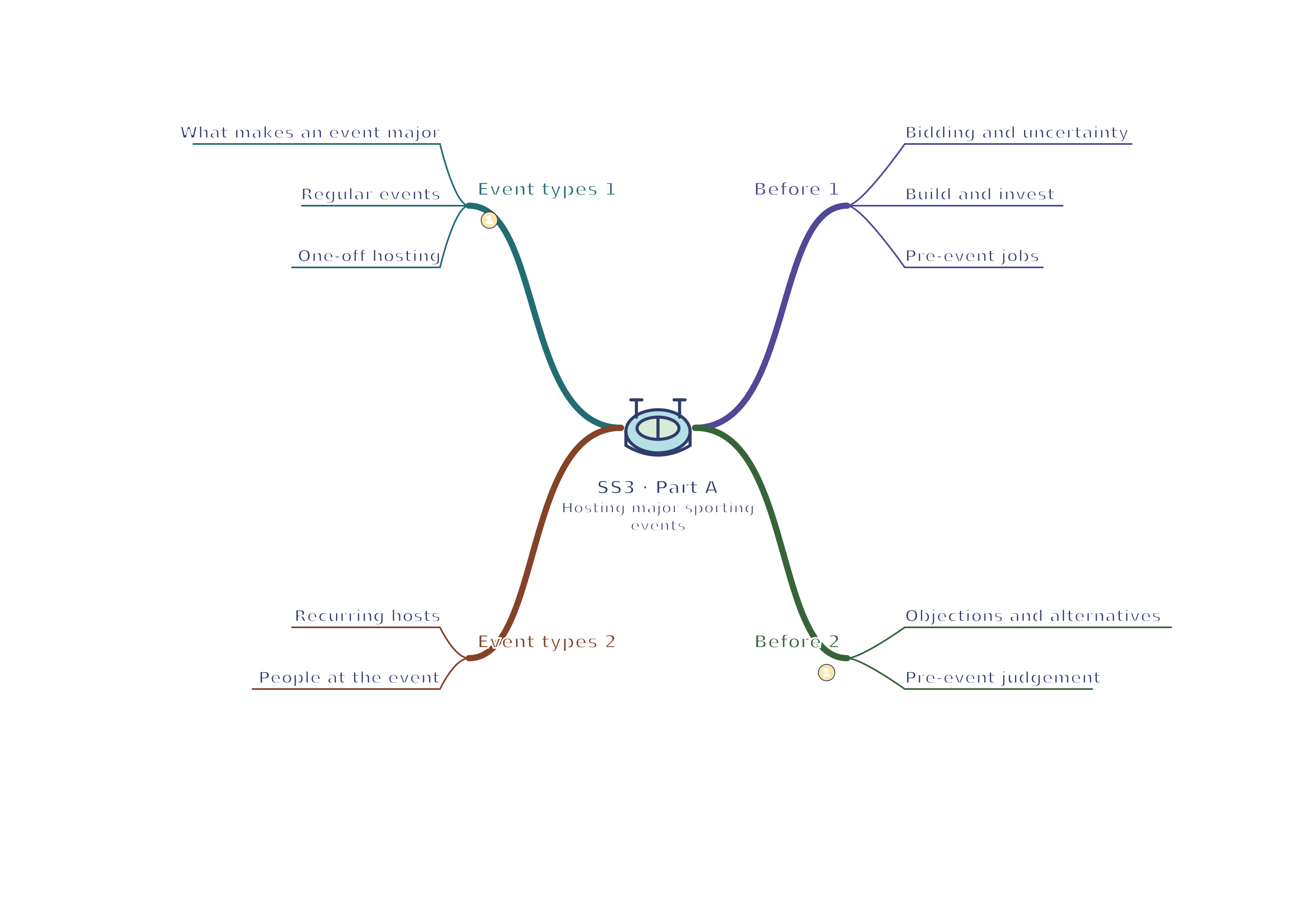
SS3 · Event types 1 / Event types 2 / Before 1 / Before 2
View SS3 · Event types 1 / Event types 2 / Before 1 / Before 2 mind mapOpen the full-size map to zoom. Use the printable view for A4 landscape or enlarge to A3.
 Mr Kidman's Classroom