Mr Kidman's Classroom


Revise the key ideas
Meaning and presentation
- Data and information — Data consists of recorded values; without headings and context, 24, 18 and 30 do not tell a manager what happened. Label them as Monday to Wednesday pool bookings and organise them in a table to create meaningful information. Processing, structure and context support interpretation. Raw data may already have a file structure; the key distinction is meaningful use.
- Choosing a representation — Text explains a conclusion, numbers give exact measures, and tables support precise comparisons. Charts show patterns; sparklines show small trends beside rows; infographics combine selected figures and visuals for an audience. Choose for the decision being made. A tiny trend line cannot replace a labelled table when exact booking totals are required.
Collection and quality
- Primary collection — Primary data is gathered first-hand for the current purpose. Interviews allow clarification and detail but are time-consuming and may be influenced by the interviewer. Questionnaires or surveys can reach more people cheaply, but unclear or leading questions and non-response distort findings. Pilot the questions and provide accessible ways to respond.
To pilot questions, try them with a small suitable group first, check for confusing wording or missing answer options, and revise them before the main collection.
- Secondary sources — Secondary data already exists: websites, books, journals, blogs, forums, booking records and internal company documents can supply it. Check who produced it, why, how and when. A booking system is useful for recorded attendance but may omit people who could not book; a forum is not automatically representative. Existing data saves collection effort but may not fit the new purpose.
- Sampling reliability — Judge sample size, who participated, where and when collection occurred, and the method. Asking only weekday swimmers misses weekend demand; more weekday responses will not remove that bias. Use a relevant spread of users and times and report limitations. A large sample can still systematically exclude people without internet access.
- Quality factors — Check source and collection method, accuracy, age, completeness, detail, format and volume. Current, complete booking records can support staffing decisions; last year's totals may not reflect a new timetable. Too little detail hides differences, while excessive irrelevant detail makes decisions harder. Match quality to the intended decision rather than declaring a source universally good.
Input checks
- Validation — Validation checks whether input meets rules, not whether it is true. A range check might allow 1–20 tickets; a type check requires a number; a presence check rejects a blank required field; a length check requires a membership code of six characters. An invented six-character code can pass the rule while still being wrong.
- Verification — Verification checks that data was copied or entered as intended. Proofreading compares the entry with its source; double entry compares two independent entries and flags disagreement. Copying the same mistake twice defeats the benefit. Use validation and verification together: an in-range attendance figure can still have been mistyped from the register.
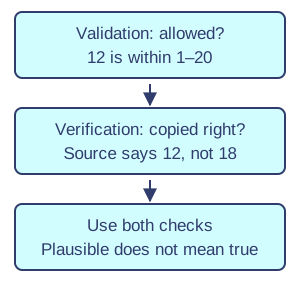
Validation and verification ask different questions. Original illustration. Open full-size diagram - Cleaning and evidence — Keep an unchanged copy of imported data, identify blanks, duplicate records, inconsistent formats and implausible values, then investigate. Record justified corrections rather than deleting inconvenient results. A zero might mean no bookings, while a blank might mean missing data; replacing every blank with zero changes averages and can mislead decisions.
Uses and effects
- Modelling in services — Transport services model demand and routes; education examines attendance and attainment; health care plans staffing and appointments; government plans services. Construction uses cost and schedule estimates, while health and safety uses incident patterns to identify risks. A model depends on input quality and assumptions; it cannot guarantee what will happen.
- Modelling in commerce and leisure — Retail models stock and sales, banking examines risk and unusual transactions, entertainment predicts audiences, communications plans network capacity, and sport or fitness tracks performance. State the decision, required variables and a limitation. A rise in ticket sales could reflect a price promotion rather than improved customer satisfaction.
- Threats to individuals — Stored data can expose private details, enable fraud or help exploit vulnerable groups. Inaccurate records may deny someone a service or cause unsuitable decisions. Restrict access, minimise collection, check accuracy and provide routes to correction. Personalisation can be useful while still needing lawful and ethical handling of personal information.