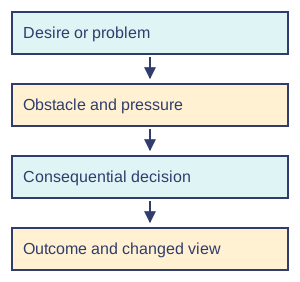
A focused idea — Begin with a manageable situation, desire or conflict. A short narrative about delivering one difficult message can develop more convincingly than a summary of an entire war. Decide what matters emotionally before adding events.
Character desire — Give a central character something to want, fear or decide. Choices reveal character when circumstances make them difficult. Avoid supplying a long list of adjectives instead of showing purposeful behaviour.
Conflict — Conflict may be between people, within a character or against circumstances. Establish what prevents an easy solution and what is at stake. Increasing violence is not the only way to develop tension.
Plot and causation — Connect events through consequences: a missed message causes a wrong decision, which creates a new problem. A list joined only by “and then” may lack a meaningful relationship. Ask why each event follows the last.Original explanatory model. Full-size diagram
Selecting an opening — Start where a relevant change begins, or establish an ordinary situation that will be disrupted. Orientate the reader enough to follow. Mystery is created by purposeful withholding, not by making every person and location unclear.
Building tension — Delay an important answer, narrow the character's options or let the reader recognise danger before the character does. Balance uncertainty with enough information to care about the outcome.
Climax and resolution — The climax brings a central conflict to a decisive moment. A resolution shows consequences or a changed understanding. An ending can remain open, but should feel connected to what has been developed rather than an unrelated surprise.
Narrative viewpoint — First person can limit knowledge to a character's experience; third person can stay close to one character or range more widely. Choose a consistent approach. Do not reveal another character's private thought accidentally in a tightly limited viewpoint.
Time and pace — Expand an important moment with selected detail and compress less important intervals. A flashback should clarify the present story rather than interrupt it without purpose. Maintain a clear relationship between event time and telling order.
Description and dialogue
Setting with purpose — Select details that influence action or mood: an unlit stairway can affect what a character sees and chooses. Place is more useful when it participates in the story rather than appearing as a detached checklist.
Sensory selection — Use relevant sights, sounds, textures, smells or tastes, without forcing all five senses into every paragraph. “The handrail left rust on her palm” gives a precise touch detail connected to an action.
Zooming attention — Move deliberately from a broad setting to a significant detail, or reverse that movement. Explain space clearly so the reader can follow. A close-up should highlight something important rather than decorate every object.
Showing and telling — Actions, dialogue and detail can let a reader infer emotion, while concise telling can move events along. “He checked the lock three times” suggests anxiety; “He was anxious” states it. Both can be useful in different places.
Precise vocabulary — Prefer the word that fits the action over the most unusual synonym. “She eased the door shut” differs from slammed or closed. Check unfamiliar vocabulary before using it; ornate language can obscure a simple event.
Figurative consistency — Choose a comparison with a clear shared quality. If a room becomes a sleeping animal, develop that image carefully or move on; mixing unrelated metaphors can confuse the picture. Figurative language is optional, not a compulsory quota.
Dialogue as action — Dialogue can reveal relationships, change a decision or conceal information. Give speakers different aims rather than making them explain facts they both already know. Omit routine greetings when they do no useful work.
Action alongside speech — A gesture can qualify spoken words: “Of course,” she said, hiding the letter. The contradiction invites inference. Avoid adding a dramatic gesture to every line; select moments that matter.
Paragraphing a scene — Start a new paragraph for a new speaker and consider breaks for changes of time, place or focus. Paragraphs help readers follow movement; they need not all be the same length.
Planning and drafting
Read the task — Underline the purpose, audience, form and any supplied conditions. Turn the task into a brief checklist before generating ideas. A beautifully written story does not fulfil a request for an explanatory article.
Generating ideas — Use notes, questions, a quick list or a visual plan to explore possibilities. Separate invention from selection so that an early idea does not automatically become the final plan. Choose relevant material rather than using everything you think of.
Prior knowledge and research — Identify what you know and what needs checking. Record the source of facts and quotations as you collect them. Research should answer a focused question rather than produce a pile of material with no role.
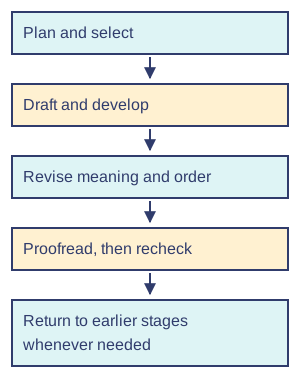
Ordering ideas — Choose an organising relationship: time sequence, cause and effect, comparison, problem and response or an argument's development. The same material may need a different order for another purpose. Make the relationship visible to the reader.Original explanatory model. Full-size diagram
Flexible plans — A plan is a guide that can change when drafting reveals a better connection or a gap. Keep the central purpose stable while adjusting the route. Finishing a plan is not more important than producing a coherent final response.
Drafting at length — Develop ideas with enough detail for the audience to follow. A draft can contain rough sentences while its argument or narrative takes shape. Build writing stamina through sustained practice rather than replacing extended work with disconnected short answers.
Paragraphs and cohesion
Paragraph unity — A paragraph groups related material around a focus or stage. A new time, place, speaker or argument can justify a break. There is no universal number of lines that makes a paragraph correct.
Topic sentences — A topic sentence can signal a paragraph's focus, especially in explanation or argument. It need not always be the first sentence, and creative writing may establish focus differently. Ensure the remaining detail develops the actual focus.
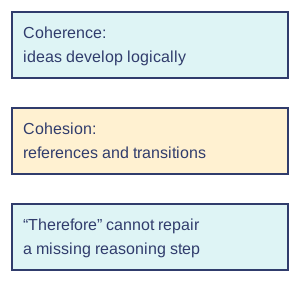
Coherence and cohesion — Coherence is the overall sense and logical organisation of a text. Cohesion concerns links between its parts, such as reference and connecting expressions. A text can contain many connectives while still lacking a coherent argument.Original explanatory model. Full-size diagram
Pronoun links — Use pronouns to avoid needless repetition, but keep reference clear. “Mina spoke to Ella after she arrived” may leave the arrival ambiguous. Replace a pronoun with a name when the reader could reasonably choose two referents.
Lexical links — Related words, deliberate repetition and synonyms can maintain a topic. “The proposal…this plan…its benefits” can link sentences. Avoid replacing a technical term with an inaccurate synonym merely to vary vocabulary.
Adverbials and transitions — Expressions such as meanwhile, as a result and in contrast signal time or logical relationships. Choose the relationship first, then the expression. Do not add furthermore to a paragraph that actually challenges the previous point.
Within and across paragraphs — A paragraph's final idea can lead into the next focus, and a new paragraph can refer back to a key issue. Read the joins separately to test the development. Each paragraph should belong to the whole text.
Avoiding repetition — Ask whether a sentence adds explanation, evidence, qualification or a new stage. Restating an idea can emphasise it deliberately, but repeated claims without development can make a text seem longer without making it clearer.
Revision and proofreading
Revision before proofreading — Revision changes ideas, organisation and expression; proofreading checks surface errors. First repair missing explanations or a confusing sequence, then inspect spelling and punctuation. Correcting commas cannot fix an argument that contradicts itself.
Testing audience needs — Read as someone who lacks your background knowledge. Define necessary terms, clarify a reference and add an omitted step. Do not explain every obvious fact at length; supply what this reader needs for this purpose.
Sentence-level editing — Replace vague wording, remove unintended repetition and make relationships explicit. Read the revision in context: a shorter sentence is not automatically clearer if it removes an important qualification.
Peer feedback — Ask a reader a focused question, such as where the explanation becomes hard to follow. Evaluate feedback against the task instead of accepting every suggestion. A useful comment identifies a specific problem and possible improvement.
Reading aloud — Reading aloud can reveal awkward syntax, missing words or accidental repetition. It does not detect every spelling error or guarantee punctuation accuracy. Combine it with deliberate visual checks and task review.
Proofreading passes — Check one concern at a time: sentence boundaries, agreement, punctuation, then likely spelling problems. Slowing down and examining endings can reveal errors familiar reading misses. Use dictionaries or approved tools to verify uncertain choices.
Using digital tools — A spellchecker can miss a correctly spelled wrong word such as form for from. Grammar suggestions may misunderstand your intended meaning or register. Read each suggestion critically and retain responsibility for the final text.
Presentation and handwriting — Make writing legible and layout appropriate to the form. In handwritten work, clear letter shapes and sensible spacing help the reader; in digital work, check headings and paragraph breaks. Decoration should not hide the content.
Worked cohesion edit — Draft: “The bus was late. It rained. The road flooded.” If flooding caused the delay, revise: “Heavy rain flooded the road, so the bus was delayed.” Only make that causal link if the source supports it; cohesion must not invent facts.
Final review — Compare the final response with the original task and plan. Check that edits have not introduced a new contradiction, lost evidence or changed a source's meaning. Submit a response that works as a whole rather than a set of separately polished sentences.
GCSE descriptive and narrative writing
Paper 1 writing task — Q5 carries forty marks: twenty-four for content and organisation and sixteen for technical accuracy. Select one option and fulfil its actual requirements. From 2026 the narrative option asks for an opening; the description may use an image imaginatively rather than reproduce every visible item. Read the precise scenario before planning.
A narrative opening — Establish a viewpoint, an intelligible situation and a disturbance or unanswered question worth following. You do not have to resolve the entire plot when an opening is requested. “The key fitted, although this house had been demolished ten years ago” establishes an unusual situation efficiently; development should make the surrounding scene coherent rather than stack unrelated shocks.
Description has movement — A descriptive piece can organise attention through space, time, contrast or a recurring detail without becoming a full action plot. Move from a broad station platform to a frayed sleeve, then the shaking hand within it, to develop isolation. A succession of unrelated sensory adjectives does not create coherent focus.
Deliberate image choices — Select a few details that establish the intended atmosphere. “Rain stitched the empty platform to the dark tracks” links setting and weather through an image; adding three incompatible comparisons can blur it. Check that the verb and comparison fit the viewpoint and that their meaning is understandable.
Character through action — “She placed the cracked cup at the back before the visitors arrived” can suggest concern with appearances without saying she was embarrassed. Actions, selected dialogue and a viewpoint's attention can imply motivation. Give readers enough concrete evidence to interpret the character; withholding all information produces confusion rather than intrigue.
Paragraph development — Let a paragraph establish a focus and develop it; change paragraphs for a meaningful shift in time, place, attention or speaker. A single-line paragraph can emphasise a turning point when its contrast with surrounding paragraphs earns the emphasis. No paragraph length or punctuation quota guarantees quality.
Control and proofreading — Keep tense, narrative person and pronoun references coherent unless a shift is deliberate and signalled. After drafting, check whether the piece fulfils the chosen option, whether images remain consistent and whether sentence boundaries are secure. Correct high-impact errors before hunting for a fancier synonym.
Practice with feedback — Write an opening and a separate description from unfamiliar prompts. Explain your intended organisation, then ask a reader where their attention or understanding changed. Revise a passage based on that evidence. Recognition quizzes cannot assess imaginative development, sustained control or the quality of an entire piece.
GCSE descriptive and narrative writing
Revise a description — Original draft: “The room was scary. There was a clock and it was noisy.” Revised: “Behind the locked door, the clock counted out each second. I kept my hand on the handle.” The revision replaces an announced emotion with selected sound, restricted space and a physical response. It keeps one viewpoint and leaves a question open. This is one possible effect, not a rule that every sentence needs personification. Read the whole paragraph to check that the detail develops its atmosphere rather than adding unrelated decoration.
Test yourself
30 questions · Random sets of 10. These quick checks support revision; practise longer explanations and justified judgements too.
Mind map
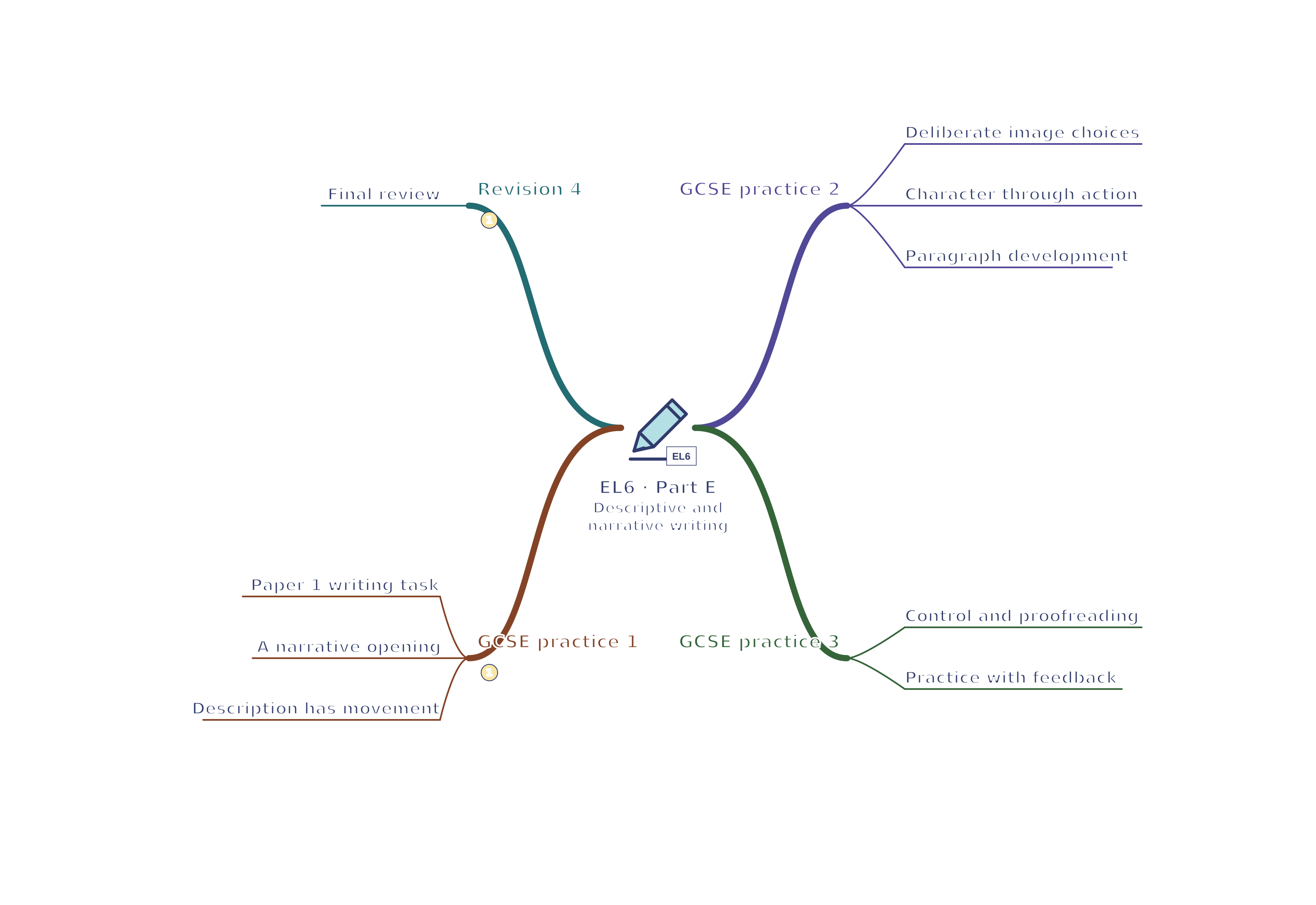
Use the branches to recall the ideas and explain their connections. Check the revision notes for the full detail.
EL6 · 1
View EL6 · 1 mind mapOpen the full-size map to zoom. Use the printable view for A4 landscape or enlarge to A3.
 Mr Kidman's Classroom