Mr Kidman's Classroom


Revise the key ideas
Sound and spelling
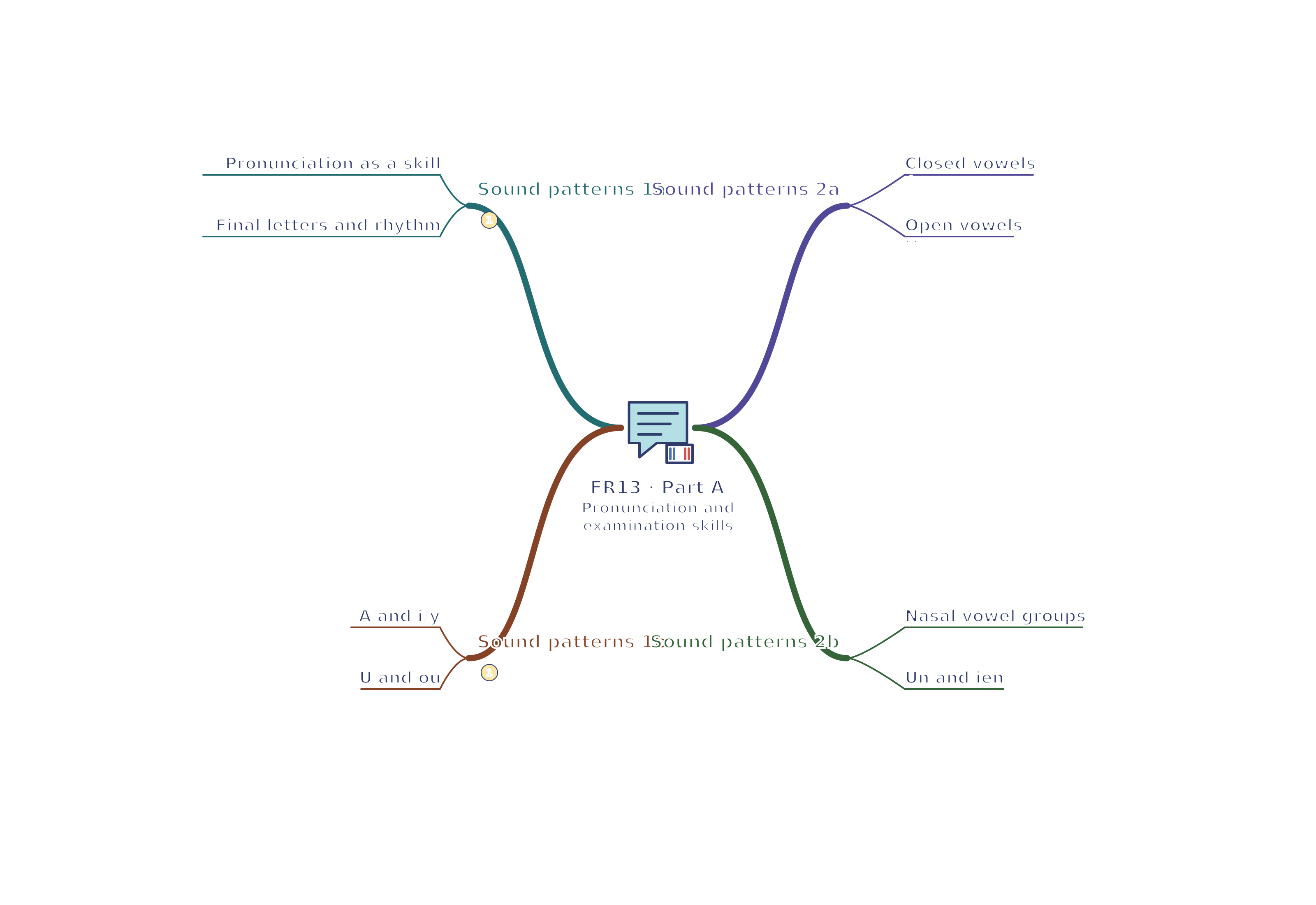
- Pronunciation as a skill — French spelling is not read with English sound values. Practise listening, repeating, reading aloud and writing from dictation, then compare with a competent speaker or reliable recording. The approximations here describe targets; silent text cannot demonstrate pronunciation or certify listening skill.
- Final letters and rhythm — Many final consonants and final e are silent: petit, parle. Final consonants are not always silent: avec and sac are counterexamples. French phrase rhythm commonly gives prominence near the end of a group, rather than strong English stress on every content word. Read in meaningful groups.
- A and i/y — A in ami is an open vowel; i and vowel y in ici/stylo have an ee-like quality. Do not turn each vowel into an English diphthong. A written y can also contribute a glide, as in voyage; context and the correspondence matter.
A diphthong moves between two vowel qualities within one syllable. For the French vowels illustrated here, keep the vowel steady rather than copying that English movement.
- U and ou — Ou in vous is close to English oo. U in tu is different: round the lips while keeping the tongue forward as for i. Practise tu/tout and rue/roue with feedback. Replacing both by oo can obscure the word.
- Closed vowels — É, infinitive -er and vous -ez often share a closed e sound: café, parler, parlez. Au/eau and closed o/ô give a rounded o sound: chaud, beau, tôt. An unaccented e may be a reduced vowel, as in je; do not assume e, é and è are identical.
Open and closed describe relative mouth opening and tongue position. The closed e/o examples use a less open mouth and a higher tongue position than their open counterparts; compare the paired words with audio.
- Open vowels — È/ê/ai in mère, fête and faire have an open e quality. Open o in porte differs from closed o in mot. Eu/œu can be closed in deux but open in peur/cœur. Practise contrasting words with a recording; English equivalents are approximations.
- Nasal vowel groups — An/en/am/em commonly mark one nasal family: dans, enfant, chambre, temps. On/om appears in nom/nombre; in/ain/aim/im in vin/pain/faim/simple. Air flows through nose and mouth; do not add a separate English n after each vowel. A following vowel can change the pattern.
- Un and ien — Un in brun has a nasal value whose distinction from in varies in standard regional speech. -ien in bien combines a glide with a nasal vowel. Aim for intelligible correspondence rather than caricaturing an accent; compare accepted spoken models.
- Consonant groups — Ch in chat is like English sh; qu in qui is k without an added w; j and soft g in jour/girafe resemble the sound in English measure. Ç and c before e/i/y are soft s: garçon, cinéma. C before a/o/u is often k unless ç changes it.
- More consonant patterns — Intervocalic single s (s between vowel sounds) is often z: maison. -Tion is often s plus a glide and nasal vowel: nation. Th in théâtre is t, not English th. H is not pronounced, but h aspiré blocks elision and liaison in words such as héros; learn it with the word.
- Glides and r — Oi/oy in moi/voyage includes a wa-like sequence. -Gn- in montagne is a palatal nasal, close to the middle of canyon. -Ill-/-ille often gives a y-like glide in fille, but ville is an exception. -Aill-/ail appears in travail. French r is commonly made towards the back of the mouth.
A glide is a quick movement into a neighbouring vowel, like the y-like sound in fille or the w-like start of moi. A palatal sound is made with the middle of the tongue near the hard roof of the mouth.
- Liaison — A normally silent consonant can sound before a vowel: les amis has an s-link pronounced z; petit ami can have t; un ami n; deux amis x-link pronounced z. Liaison depends on construction and may be forbidden, including after et. H aspiré blocks it. Do not join every final consonant indiscriminately.
Listening and speaking
- Listening method — Read the question and predict the type of detail needed: person, number, reason or time. Listen for the whole clause, especially negatives, tense and correction words such as mais. Use the permitted listening opportunities to check uncertain details. A familiar word alone is not the answer.
- Dictation — Listen for a phrase, hold its meaning and write the words, then check articles, elision, agreement and silent endings. Les amis parlent has several silent written endings; sound alone may not determine them without grammar. Accents can distinguish forms such as a/à and ou/où.
- Speaking tasks — The AQA speaking assessment includes a role-play, reading aloud with short unprepared questions, and a photo-card discussion. Practise the current official format with your teacher. Respond to prompts and questions rather than delivering an unrelated script; ask the required question when prompted.
- Read aloud — Scan punctuation, mark sense groups and identify likely sound correspondences before speaking. Maintain understandable pace and phrase rhythm. If you make an error, correct it briefly and continue. A listener must judge intelligibility; spelling quizzes do not measure the spoken result.
- Photo and conversation — Start with observable detail: Sur la photo, il y a… Then distinguish observation from possibility: peut-être… means perhaps. Answer the actual follow-up, justify opinions and develop relevant time frames. Do not invent certainty about people's emotions, relationships or location.
Reading, writing and translation
- Reading method — Read the question, locate the relevant clause and identify who does what, when, and with what qualification. Follow pronouns, contrast and negatives. Cognates help but actuel means current and librairie means bookshop. A glossed unfamiliar word should be used with the surrounding grammar.
- Vocabulary and morphology — Learn the prescribed AQA vocabulary across contexts, including irregular forms and additional tier content. Curated topic keyword sheets do not replace the complete official list. Reading permits specified regular derivations; do not assume an unfamiliar word can always be guessed from English.
- Translation into English — Read the whole French sentence, resolve subject/pronouns/negation/tense, then write natural English preserving all meaning. Il me manque means I miss him, literally he is missing to me. Avoid translating each word mechanically or dropping a restriction such as seulement (only).
- Translation into French — Identify time frame and subject, select a known construction, then check verb, articles, agreement, prepositions, accents and spelling. She went to France gives Elle est allée en France: être auxiliary, feminine participle and country preposition all matter.
- Extended writing — Address every requested bullet and the stated length, selecting relevant ideas with clear reasons and appropriate time frames. Use language you can control, then proofread. More complex grammar improves an answer only when it conveys the intended meaning accurately; no fixed memorised paragraph fits every task.
- Assessment and practice — Listening, Speaking, Reading and Writing each contribute to the qualification; Foundation and Higher have different task demands. Use the current AQA instructions for timing, word counts and assessment conditions. Practise each skill with authentic task evidence; short checks sample knowledge and strategy.
- Tier and weighting — Each paper is worth 25%. Foundation targets grades 1–5; Higher grades 4–9. All four papers must be taken at the same tier and in the same series. Choose the route with your teacher.
- Listening paper — Paper 1 lasts 35 minutes at Foundation and 45 at Higher, including five minutes to read before the recording and two at the end to check. Section A responses are English or non-verbal; Section B is dictation. The invigilator controls the repetitions and pauses.
- Speaking assessment — Foundation speaking lasts 7–9 minutes and Higher 10–12, with 15 minutes of supervised preparation. Role-play, read-aloud with unprepared conversation, and photo discussion contribute 10, 15 and 25 marks. Follow the actual preparation rules.
- Reading paper — Paper 3 lasts 45 minutes at Foundation and 60 at Higher. Comprehension carries 40 marks and French-to-English translation 10. Comprehension answers are English or non-verbal as directed. Translation contains at least 35 source words at Foundation and 50 at Higher.
- Foundation writing tasks — Foundation writing lasts 70 minutes: five photo sentences, about 50 words covering five bullets, five grammar tasks, English-to-French translation totalling at least 35 words, and about 90 words covering three bullets, chosen from two tasks. Allocate time to every required question and proofreading.
- Higher writing tasks — Higher writing lasts 75 minutes: translation totalling at least 50 source words, a choice of 90-word tasks covering three bullets, and a choice of 150-word tasks covering two bullets. These carry 10, 15 and 25 marks respectively. Develop relevant responses rather than unrelated memorised paragraphs.
- Independent review — Take one unfamiliar passage, one dictated phrase, one unprepared exchange and one writing task. Record what the evidence shows, select a specific PLC goal and practise it again after feedback. Gap finder recommendations use sampled checks; green confidence is not external certification.