Effective performance — Judge a performance against its purpose, rules and agreed criteria. A successful outcome may involve technique, decisions, teamwork, control or expression. The final score is useful information but cannot explain every contribution or whether the method was effective.
Observation — Choose a manageable focus and record specific examples from actual performance. Separate observation, such as a pass reached a marked target, from interpretation, such as the player scanned early. Check the evidence before turning an inference, an explanation you draw from what you notice, into a fact about motivation or ability.
Comparable measures — Use the same task, distance, equipment and scoring method where possible when comparing attempts. Record relevant changes such as opponent, surface or timing method. A larger number may be better for a jump but worse for a timed run; understand the measure’s meaning.
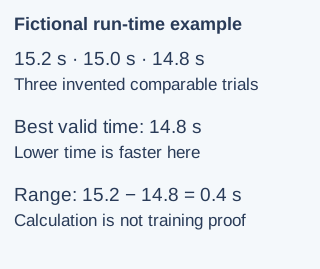
Simple data — An invented practice example has run times of 15.2, 15.0 and 14.8 seconds under stated similar conditions. The best is 14.8 seconds because less time means a faster run over the same distance. Range is the highest value minus the lowest: 15.2 − 14.8 = 0.4 seconds. These are fictional data for learning, not actual pupil results or proof of a training programme’s effectiveness.Fictional comparable run times: 15.2, 15.0 and 14.8 seconds. Lower is faster here; range is 0.4 seconds. These are teaching numbers, not actual pupil or programme outcomes. Full-size diagram
Feedback and goals
Specific feedback — State what happened, where and how it affected the task, then suggest one practicable action. Create a clearer passing angle after your pass is more useful than try harder. Feedback should be respectful and include the learner’s understanding of the problem.
Goal setting — A useful goal specifies the improvement, evidence and review point, with a realistic method. For example, create an open support option on four of five observed opportunities in the next agreed modified game is more informative than win more. Choose criteria suitable to the actual activity and learner rather than imposing one target on everyone.
Practice design — Match practice to the issue. An isolated technical rehearsal may build control; a conditioned game, with an agreed rule changed to focus on a skill or decision, can add a relevant decision; a full performance tests transfer. Increase challenge deliberately and adjust when the task is too easy, unsafe or too difficult to support learning.
Review cycle — Observe a baseline, an initial performance recorded so later attempts can be compared with it, select an issue, practise, retest and reflect. Explain whether the evidence supports progress and what else may have influenced it. A disappointing single trial does not prove no learning; look at repeatable performance, context and specific changes.
Competition and responsibility
Roles beyond performer — Officials, organisers, coaches and supportive teammates contribute to activity. Each role needs suitable knowledge and boundaries; a pupil leader follows the teacher’s agreed procedures rather than taking over specialist safety decisions. Leadership includes listening, clarity and fair opportunities.
Rules and ethics — Use the current rules or declared modifications, apply them consistently and respect the official’s permitted process. Report unsafe conduct or concerns to a responsible adult. Fair play includes honesty about outcomes and recordings, not only accepting a result when it suits your side.
Pressure and response — Competition can bring excitement or anxiety. Prepare familiar routines, focus on controllable actions and use appropriate support from teachers or trusted adults. Do not diagnose someone’s mental health from a performance or assume that all pressure is beneficial for every participant.
Continuing participation
Community links — Find real suitable clubs, leisure centres, school-community activities or dance groups through trusted official sources. Check age group, access, cost, travel, supervision and an introductory opportunity with a responsible adult. A generic invented club is not evidence that a real local opportunity exists.
Barriers and solutions — Time, cost, transport, confidence, discrimination, facilities and access can affect participation. Ask what the learner actually needs before proposing an adjustment. A lower-cost session, accessible venue or supportive beginner group may help, but one solution will not remove every barrier.
Choice and enjoyment — Different people value competition, cooperation, expression, outdoor challenge or social contact. Explore more than one appropriate activity and notice what supports sustained involvement. Choosing a different activity can be a positive informed decision rather than evidence of failure.
Long-term participation plan — Create a realistic supported next step using a verified opportunity and a reason connected to interests and needs. Include how to obtain information, who can help and when to review the experience. Keep personal contact/location details private in public work, and evaluate actual participation rather than claiming a plan has already happened.
Test yourself
50 questions · Random sets of 10. These quick checks support revision; practise longer explanations and justified judgements too.
Mind map
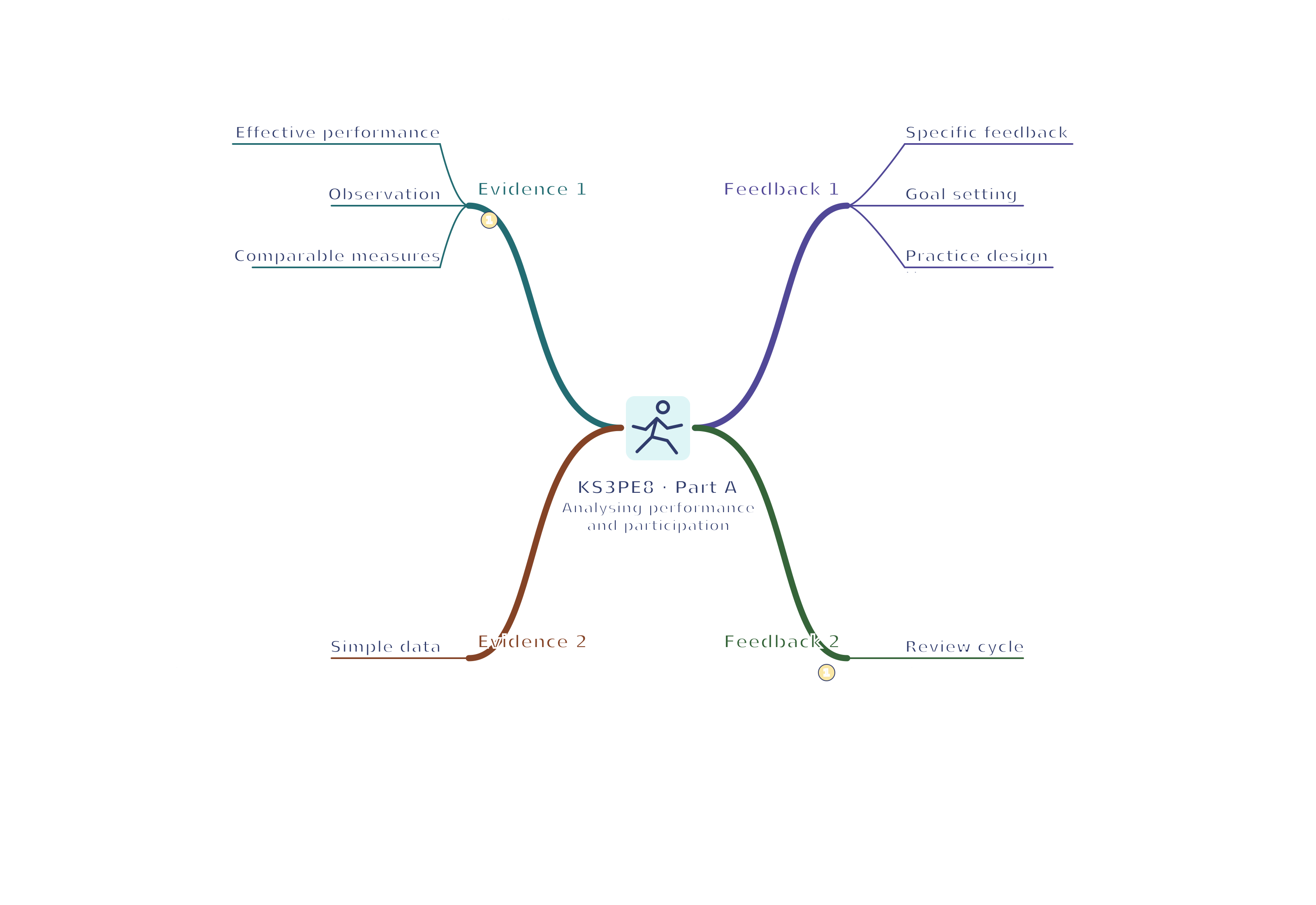
Use the branches to recall the ideas and explain their connections. Check the revision notes for the full detail.
KS3PE8 · 1
View KS3PE8 · 1 mind mapOpen the full-size map to zoom. Use the printable view for A4 landscape or enlarge to A3.
 Mr Kidman's Classroom